Before you resize a cloud VM or standardize a rack image, know what AMD vs Intel looks like under Linux — not retail spec sheets. The kernel exposes the same tools on both vendors: lscpu, /proc/cpuinfo, frequency drivers, and NUMA layout. Differences show up in topology (CCD/CCX vs mesh), SMT behavior under load, and how databases like memory locality.
Related: uname & architecture,
htop,
ESXi CPU requirements.
Vendor flags in /proc/cpuinfo
One line identifies the CPU family Linux sees — critical before you import wrong binary builds.
grep -m1 'vendor_id\|model name' /proc/cpuinfo
# vendor_id       : AuthenticAMD
# vendor_id       : GenuineIntel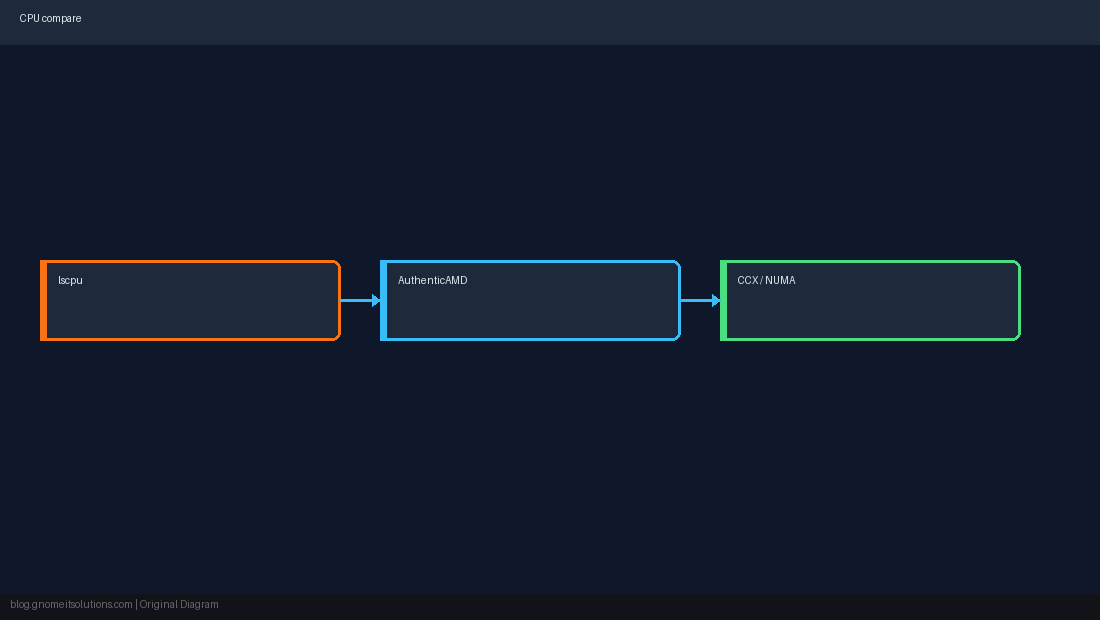
Cores, threads, and SMT
AMD uses SMT (often called threads per core); Intel historically marketed Hyper-Threading. Linux counts Thread(s) per core in lscpu — schedulers treat logical CPUs equally, but noisy-neighbor risk differs by workload.
lscpu | egrep 'Socket|Core|Thread|CPU\(s\)'Server topology: EPYC vs Xeon
AMD EPYC often exposes multiple NUMA nodes per socket (CCD-based). Intel Xeon Scalable uses a mesh; node count varies by SKU. Same DRAM total can perform differently unless you pin jobs.
CPU(s) and sometimes NUMA in lscpu. Treat advertised vCPUs as logical processors unless the provider documents dedicated cores.Practical picking (Linux hosting)
Intel: long ISV certification lists on legacy stacks. AMD: strong core-per-dollar on KVM/LXC dense hosts when your apps are Linux-native. Always validate with your exact kernel, firmware, and storage stack — not a generic benchmark blog.
hostnamectl
lscpu --extended
systemd-detect-virtPackages and microcode
Both need current microcode/firmware for security errata. Use distro packages (intel-microcode, amd64-microcode) and reboot during maintenance.
shared_buffers, JVM heap, nginx worker count) — do not copy tuning from a smaller socket count.Quick Reference
- Vendor:
grep vendor_id /proc/cpuinfo - Topology:
lscpu - Servers: check NUMA before pinning DBs
Related tutorials
Diagrams are original illustrations by Gnome IT Solutions. Tutorial text © Gnome IT Solutions.